

India's Urban Story Is Not One Story. It Is Four.
Rajesh Shukla
India's Urban Story Is Not One Story. It Is Four.
Understanding the Four Urban Economies Driving India's Transformation
Urban India is often portrayed as a single, homogeneous economy. Yet India's cities differ enormously in their size, economic structure, income levels, consumer behaviour and future growth potential. Treating them as one category masks these differences and limits our understanding of how urban India is evolving.
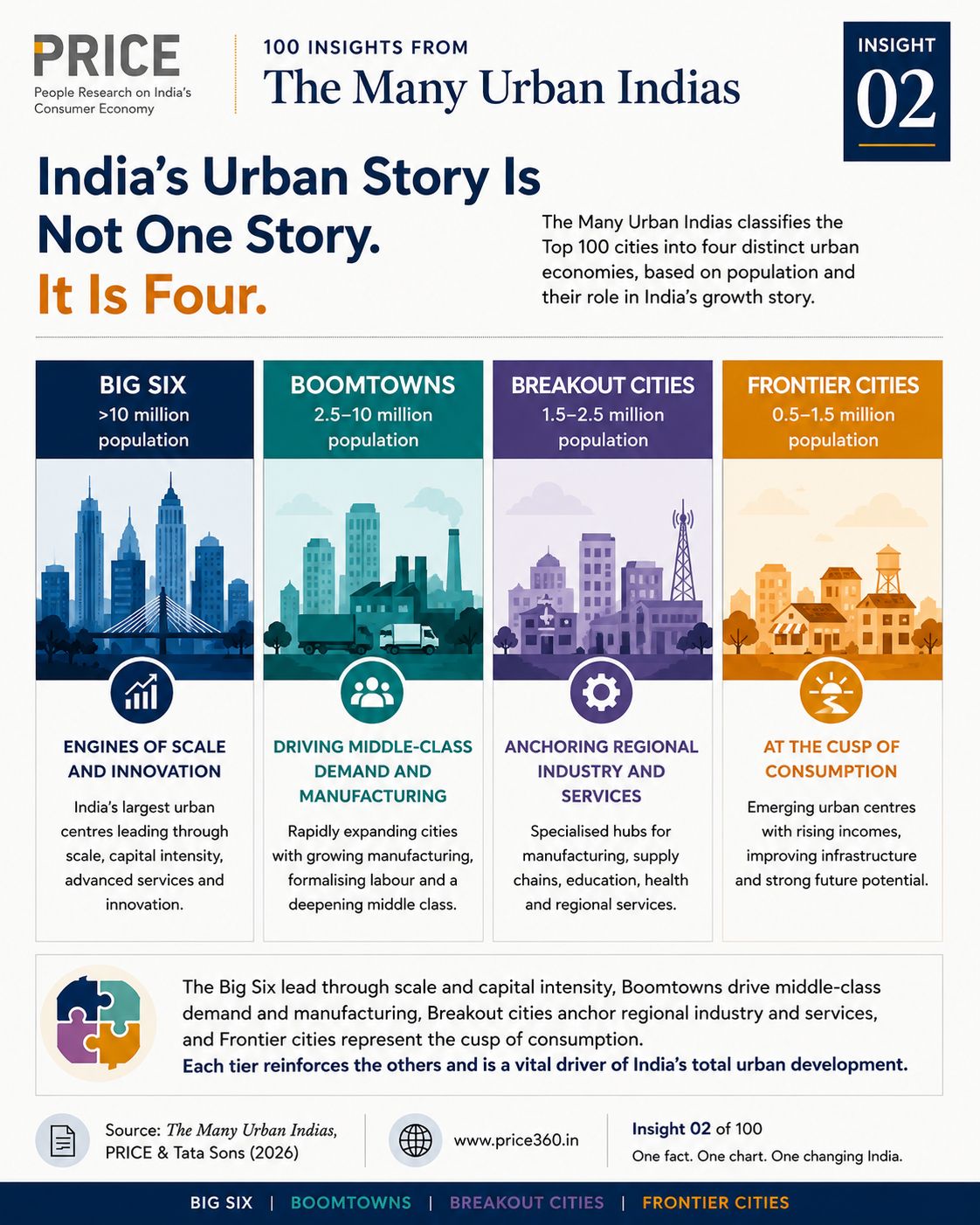
One of the principal contributions of The Many Urban Indias is the development of a new framework that classifies India's Top 100 cities into four distinct urban economies. Based on population size and supported by detailed household-level analysis, this framework captures the different roles cities play in shaping India's economic future.
The Big Six, each with a population exceeding 10 million, remain the country's largest metropolitan economies. These cities lead through scale, capital intensity, advanced services and innovation. They continue to be India's principal centres for finance, technology, corporate headquarters and global business integration.
The next 19 Boomtowns, with populations between 2.5 and 10 million, represent India's expanding industrial and commercial hubs. These cities are characterised by growing manufacturing, increasing formalisation of employment and the rapid expansion of middle-class households. They are becoming important engines of production as well as consumption.
The following 25 Breakout Cities, with populations between 1.5 and 2.5 million, function as regional anchors for specialised industries and services. Many have developed competitive strengths in manufacturing, education, healthcare, logistics and trade, linking regional economies with national and global markets.
Finally, the 50 Frontier Cities, each with populations between 0.5 and 1.5 million, represent India's next frontier of urban development. These cities are witnessing rising incomes, improving infrastructure and expanding consumer aspirations. Although smaller in scale, they hold significant long-term potential and are likely to contribute increasingly to India's future growth.
Importantly, these four categories should not be viewed as a hierarchy. Each performs a distinct and complementary role within India's urban economy. The Big Six provide scale and innovation; Boomtowns drive manufacturing and middle-class demand; Breakout Cities strengthen regional industry and services; and Frontier Cities represent the cusp of the country's next wave of consumption and opportunity. Together, they form an interconnected urban ecosystem that underpins India's economic transformation.
For policymakers, this framework underscores the need to move beyond one-size-fits-all urban policies. Different categories of cities require different approaches to infrastructure, mobility, housing, industrial development, digital connectivity and public service delivery.
For businesses and investors, the classification provides a more practical lens for evaluating market opportunities. Rather than relying solely on population rankings, firms can identify cities based on their economic function, purchasing power and growth trajectory.
India's urban future will not be shaped by a handful of metropolitan regions alone. It will be built collectively by the Big Six, Boomtowns, Breakout Cities and Frontier Cities, each reinforcing the others in driving prosperity, employment and innovation. Recognising these multiple urban economies is essential for understanding the true nature of India's urban transformation.