

Prosperity Is No Longer Defined by City Size
Rajesh Shukla
Prosperity Is No Longer Defined by City Size
India's Most Prosperous Cities Are Not Always Its Largest
For decades, India's urban narrative has been dominated by its largest metropolitan centres. The common assumption has been straightforward: larger cities are richer, spend more and offer the greatest economic opportunities. The evidence from The Many Urban Indias tells a more nuanced story.
Our analysis of India's Top 100 cities reveals that prosperity and purchasing power are no longer determined simply by population size. While the Big Six continue to play a vital role in the national economy, several smaller cities have emerged as leaders in household income and consumer spending.
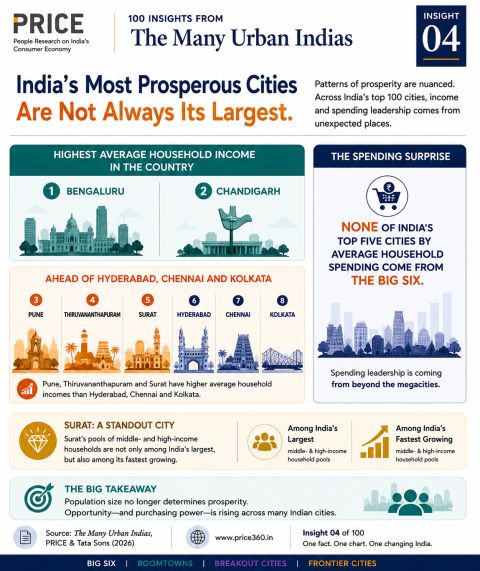
The findings show that Bengaluru and Chandigarh record the highest average household incomes in the country. Even more remarkably, Pune, Thiruvananthapuram and Surat report higher average household incomes than Hyderabad, Chennai and Kolkata—three of India's largest metropolitan cities.
The consumption story is even more revealing.
None of India's top five cities by average household spending belongs to the Big Six.
This finding challenges the conventional practice of assessing market potential solely through population rankings. Household prosperity is increasingly shaped by a city's economic structure, industrial competitiveness, entrepreneurial ecosystem, employment opportunities and quality of life rather than its size alone.
Among these emerging urban success stories, Surat stands out as one of India's most dynamic cities. It has developed one of the country's largest concentrations of middle- and high-income households while simultaneously recording one of the fastest rates of growth in these income groups. Built on a strong foundation of manufacturing, textiles, diamonds, entrepreneurship and trade, Surat demonstrates how specialised regional economies can generate sustained prosperity without becoming megacities.
The broader lesson extends well beyond individual cities.
India's future urban growth will not be driven exclusively by its largest metropolitan regions. Increasingly, prosperity is spreading across multiple tiers of cities, each contributing differently to the country's economic transformation. The rise of these high-performing cities reflects a more balanced and diversified pattern of urban development than is often recognised.
For policymakers, this underscores the importance of designing urban strategies that recognise the distinct strengths and growth trajectories of different cities. Investment decisions should increasingly consider economic performance, productivity and household well-being alongside population.
For businesses, the message is equally compelling. The next generation of consumer markets may not always be India's largest cities. Companies that identify where household incomes and purchasing power are rising fastest will be better positioned to capture future growth.
India's urban economy is therefore becoming more diverse, more competitive and more geographically dispersed. Understanding this changing geography of prosperity will be critical for anyone seeking to understand India's economic future.